Persona 6 Fans Are Currently in the Best Part of the Entire Game
Internet Culture ?? Comments Tue 09 June 2026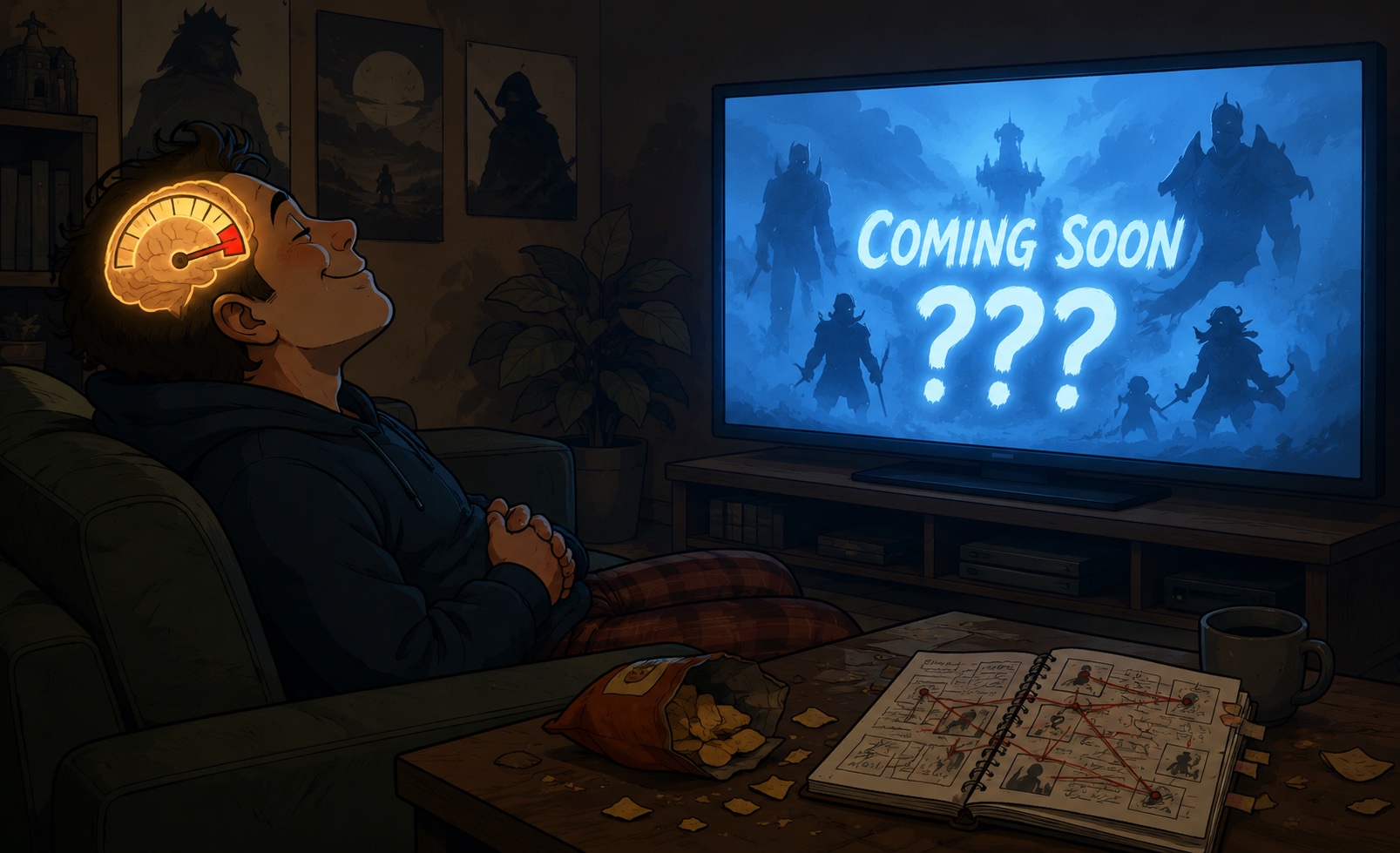
🎮 📣 🧠 💉 📈 🎯 ⬇️ 😶
TL;DR: Dopamine fires hardest during uncertain anticipation, not at delivery — meaning Persona 6 fans peaked neurologically the moment the announcement dropped, and the actual game is science's definition of diminishing returns.
The Situation
Something significant happened in the gaming world this week. Atlus dropped just enough information about Persona 6 — a title, a few carefully vague details, the implication of a setting — to send approximately 50,000 people per day to Google and several Reddit communities into a state that can only be described as productive frenzy. Fans are theorising about cities, protagonists, Personas, school uniforms, and shadow archetypes. The discourse is rich. The spreadsheets are elaborate. The commitment is total.
Meanwhile, in a Kyoto University laboratory that had no idea any of this was happening, a team of neuroscientists published a study in the Proceedings of the National Academy of Sciences that described, in precise fluorescent-sensor detail, exactly what is happening in those fans' brains. The study tracked dopamine release in the striatum of rhesus macaques during probabilistic reward tasks — situations where a reward might come, or might not, depending on conditions the subjects couldn't fully predict. What they found was unambiguous: dopamine signals in the anterior putamen responded most strongly to unpredicted rewards and reward-predicting cues under uncertainty. The signal was sharpest not when the reward arrived, but during the window of not-yet-knowing.
This is the neurological condition Persona 6 fans are currently living in. The announcement exists. The game does not. The reward is real but undelivered, uncertain in its details, and surrounded by exactly the kind of probabilistic cues — a tagline, a logo, a producer interview carefully edited to reveal nothing — that the Kyoto team identified as maximally dopaminergic. By every measurable striatal standard, the current moment is the best the franchise has ever made anyone feel.
By the Numbers
| Metric | Value |
|---|---|
| Daily Google searches for "Persona 6" as of June 8, 2026 | 50,000+ |
| Dopamine signal: uncertain anticipation vs. predicted reward | Significantly higher (anterior putamen, PNAS 2025) |
| Time until Persona 6 release | Unknown — which is, per the above, the optimal answer |
| Striatal region with weakest response once outcome is predictable | Caudate head |
The Kyoto researchers used a fluorescent dopamine sensor in task-performing rhesus macaques to directly observe striatal dopamine transients in real time — not a survey, not a self-report study. The signal was measurable, reproducible, and strongly tied to the uncertainty window. Once rewards became predictable, the response flattened.
The Deeper Question Nobody Asked
If dopamine peaks during anticipation of an uncertain reward, and Atlus has now spent thirty years learning precisely how to manufacture uncertain anticipation, then the question is not whether Persona 6 will be good — it is whether it is even possible for a delivered product to neurochemically match the event that precedes it. The trailers will come, the demo will drop, the reviews will land, and each step will resolve uncertainty, which is another way of saying each step will reduce the dopamine signal. Fans are not waiting for the game. They are already playing it, in the only format neuroscience confirms is peak performance. Is it possible that the best Persona game is always the one that hasn't come out yet?
Sources
- Dopamine signals in primate brains — ScienceDaily / Kyoto University, March 2025 — fluorescent monitoring of dopamine transients in macaque striatum during probabilistic reward tasks shows strongest signals during reward-predicting uncertainty
- Persona 6 — Google Trends — Google Trends, June 8, 2026 — 50,000+ daily searches confirmed active
Tags: gaming dopamine anticipation reward-prediction persona