Science Explains Why You Block People After One Unanswered Text
Relationships ?? Comments Tue 09 June 2026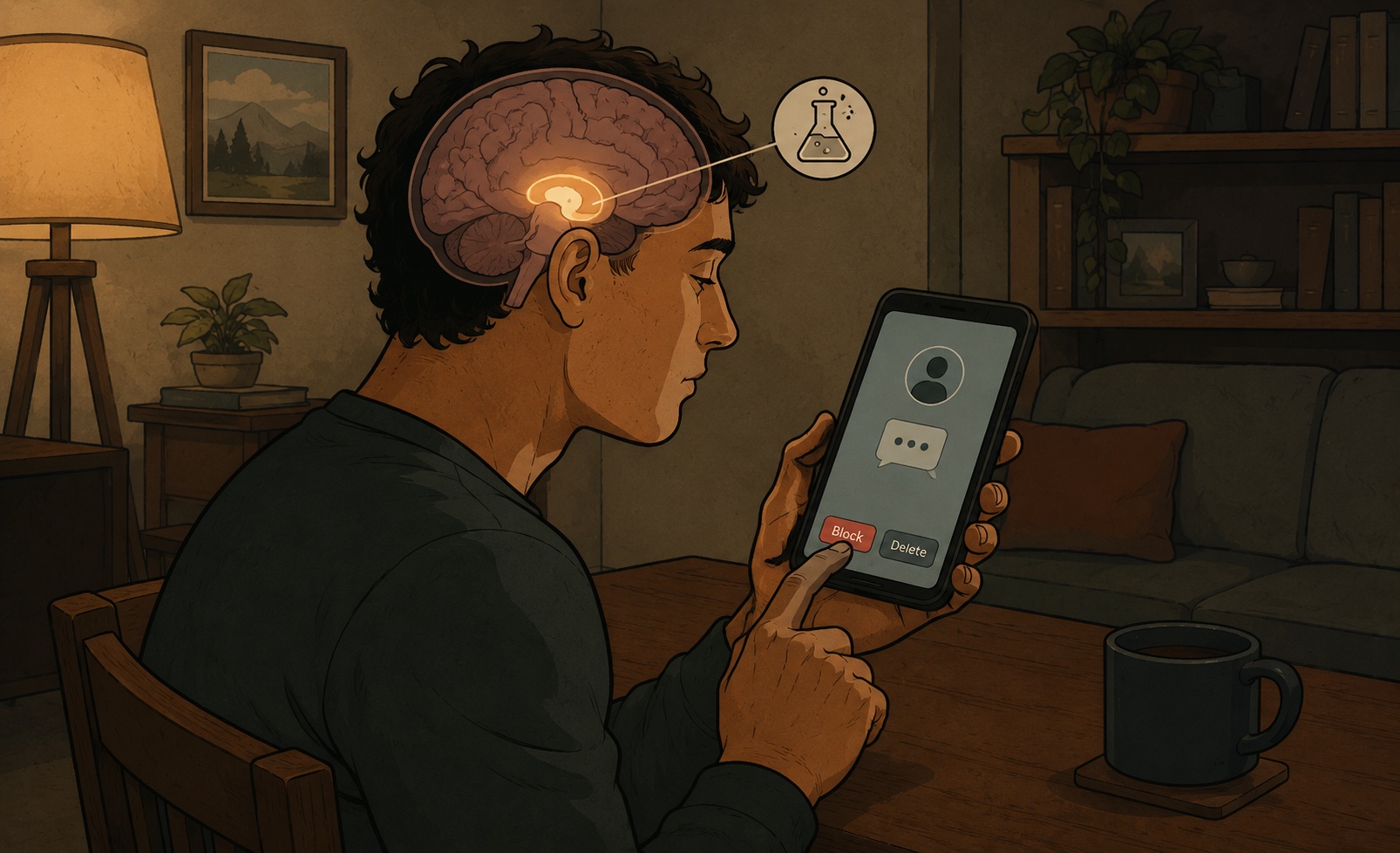
📱 ⏳ 🧠 💥 ⚗️ 🚫 👤 ✅
TL;DR: Neuroscientists discovered that a single missed reward triggers a measurable acetylcholine surge in the striatum that drives lose-shift behaviour — the technical term for what you do when you block someone on Thursday because they left you on read on Wednesday.
The Situation
There is a pattern that has been extensively documented across TikTok, X, and a significant portion of relationship advice discourse in 2026: the immediate, total, and unapologetic exit from a person, situation, or employer the moment they fail to deliver a single expected interaction. "Let me down once and I'm done" has become less a red flag and more a generational operating system. Therapists have opinions. The comments are supportive. The blocked contacts list grows longer.
Researchers at the Okinawa Institute of Science and Technology were not studying this phenomenon. They were studying mice in a virtual maze. What they found, published in Nature Communications on June 8, 2026, was a precise neurochemical account of exactly what happens in a brain the moment an expected reward fails to arrive.
When mice navigated a maze and then did not receive the reward they had been trained to expect, researchers observed a significant surge of acetylcholine released by cholinergic interneurons in the striatum — the brain's habit and decision-making hub. The greater the acetylcholine release, the more likely the mouse was to immediately abandon its current strategy and try a completely different approach. The researchers called this "lose-shift behaviour." When acetylcholine production was chemically blocked, the mice became significantly less likely to change course, even after repeated disappointments. Without the chemical signal, they persisted. With it, they were gone.
By the Numbers
| Finding | Detail |
|---|---|
| Neurotransmitter responsible | Acetylcholine, released by cholinergic interneurons in the striatum |
| Trigger | A single instance of expected reward not arriving |
| Effect | Significantly increased probability of immediate strategy abandonment (lose-shift) |
| When acetylcholine was blocked | Mice became markedly less likely to change choices after non-reward |
| Published | Nature Communications, June 8, 2026 — OIST Graduate University |
Importantly, not all cholinergic clusters responded identically. Some small groups showed little change or even decreased activity — which the researchers suggest may preserve memory of the previous strategy in case circumstances change again. The brain, it turns out, blocks the person but keeps their number, just in case.
The Deeper Question Nobody Asked
The researchers note that understanding acetylcholine's role in behavioural flexibility could eventually inform treatments for addiction, OCD, and Parkinson's disease — conditions defined by difficulty abandoning outdated strategies. It is worth sitting with the implication that the same neurochemical circuit responsible for freeing people from addiction is the one that fires when someone reads your message and does not respond within forty minutes. The lose-shift mechanism exists to help living creatures survive rapidly changing environments. Whether a situationship qualifies as a rapidly changing environment is, perhaps, a matter of personal threshold. Is the modern blocked-contacts list the striatum's most efficient product?
Sources
- Scientists discover the brain chemical that helps you break bad habits — ScienceDaily / OIST Graduate University, June 8, 2026 — acetylcholine surge in striatum drives lose-shift behaviour after missed reward; blocking acetylcholine reduces behavioural flexibility
- "Let me down once and I'm done" — viral discourse — TikTok / X, confirmed active June 2026 — generational discourse about immediate relationship exit after single letdown
Related Content
- The Reason Your Childhood Sleepover Memories Are Unnervingly Clear Is Now Peer-Reviewed
- Your AI Doesn't Understand You. Scientifically, the Bees Might.
- Your Brain Decided Whether You'd Like Someone Before You Opened Tinder
Tags: neuroscience relationships habits acetylcholine decision-making