The Reason Your Childhood Sleepover Memories Are Unnervingly Clear Is Now Peer-Reviewed
Science ?? Comments Tue 09 June 2026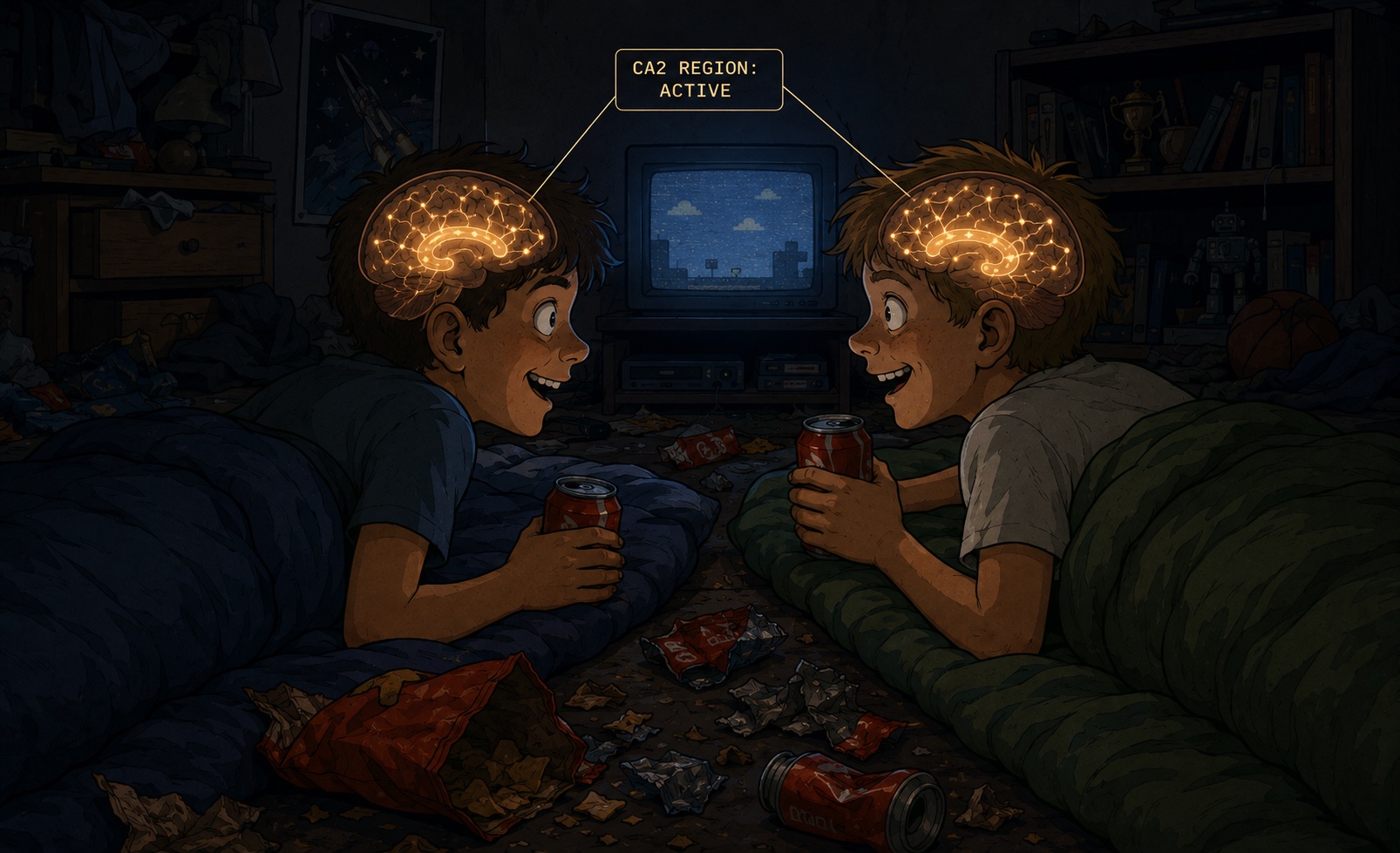
🛌 🕐 🥤 🧠 💡 👦👧 📋 ✅
TL;DR: Scientists discovered that staying up late damages a specific social memory circuit in the brain, and that caffeine precisely repairs it — which is a peer-reviewed description of every childhood sleepover you have ever attended.
The Situation
There is a viral thread doing significant numbers across TikTok, Reddit, and X right now, in which adults are sharing the specific, bizarre, and often inexplicably detailed memories they retain from childhood sleepovers. Not general impressions — specific memories. The exact texture of a sleeping bag. The precise episode of a TV show someone's older sibling had on. The exact words someone said at 2am that made everyone collapse laughing. For a generation that routinely cannot remember what they ate for lunch on Tuesday, the clarity of sleepover memories is a documented anomaly that has produced extensive commentary.
Researchers at the National University of Singapore's Yong Loo Lin School of Medicine were not aware of this thread. They were studying the hippocampal CA2 region — a small, specific area of the brain that handles social memory, the capacity to recognise and distinguish people encountered before. What they found, published in Neuropsychopharmacology in May 2026, was a precise neurochemical mechanism for how sleep deprivation damages this circuit, and how one substance reverses the damage with targeted precision.
The substance is caffeine. The study found that five hours of sleep loss disrupted synaptic plasticity in the CA2 region, weakening neural connections responsible for forming and retaining social memories. Caffeine, administered through drinking water, restored the disrupted pathway and reversed the social recognition deficits — not by broadly stimulating the brain, but by specifically restoring the impaired circuit through adenosine receptor modulation. Control animals that had not experienced sleep deprivation showed no signs of overstimulation from the same caffeine dose. The effect was, in the researchers' own framing, "highly targeted."
By the Numbers
| Element | Detail |
|---|---|
| Brain region targeted | Hippocampal CA2 — the social memory hub |
| Sleep lost in study protocol | 5 hours |
| Effect of sleep deprivation | Disrupted synaptic plasticity in CA2; social recognition memory deficits |
| Caffeine's action | Blocked adenosine receptor signalling; restored CA2 plasticity to normal levels |
| Effect on control animals (no sleep deprivation) | No excessive neural stimulation — effect was circuit-specific |
| Published | Neuropsychopharmacology, May 30, 2026 — NUS Medicine |
The viral thread's most-upvoted entries specifically mention the social details: who said what, who laughed, who cried, who someone had a complicated friendship with by morning. The CA2 region handles exactly this category of information.
The Deeper Question Nobody Asked
The researchers plan to continue investigating how caffeine influences memory consolidation and retrieval, with a view toward future treatments for cognitive decline. This is an admirable goal. It is also, entirely separately, a confirmation that the standard sleepover protocol — awake until 3am, sustained by a two-litre bottle of cola — constituted, per the current scientific record, an accidental clinical trial of the exact intervention researchers are now studying deliberately. Every child who stayed up too late drinking too much cola accidentally enrolled themselves in a study with a solid mechanistic basis and a positive outcome on social memory. The only variable the researchers added was a control group. Did childhood accidentally produce better neuroscience than we gave it credit for?
Sources
- Caffeine reversed memory problems caused by sleep deprivation — ScienceDaily / NUS Medicine, May 30, 2026 — caffeine restored hippocampal CA2 synaptic plasticity and social memory deficits caused by sleep deprivation via targeted adenosine receptor modulation
- Childhood sleepover memories viral thread — BuzzFeed / TikTok, confirmed active June 2026 — millions of adults sharing unnervingly specific sleepover memories
Related Content
- Science Explains Why You Block People After One Unanswered Text
- Your AI Doesn't Understand You. Scientifically, the Bees Might.
- Your Brain Decided Whether You'd Like Someone Before You Opened Tinder
Tags: neuroscience memory sleep-deprivation caffeine childhood