Your Brain Decided Whether You'd Like Someone Before You Opened Tinder
Relationships ?? Comments Sat 06 June 2026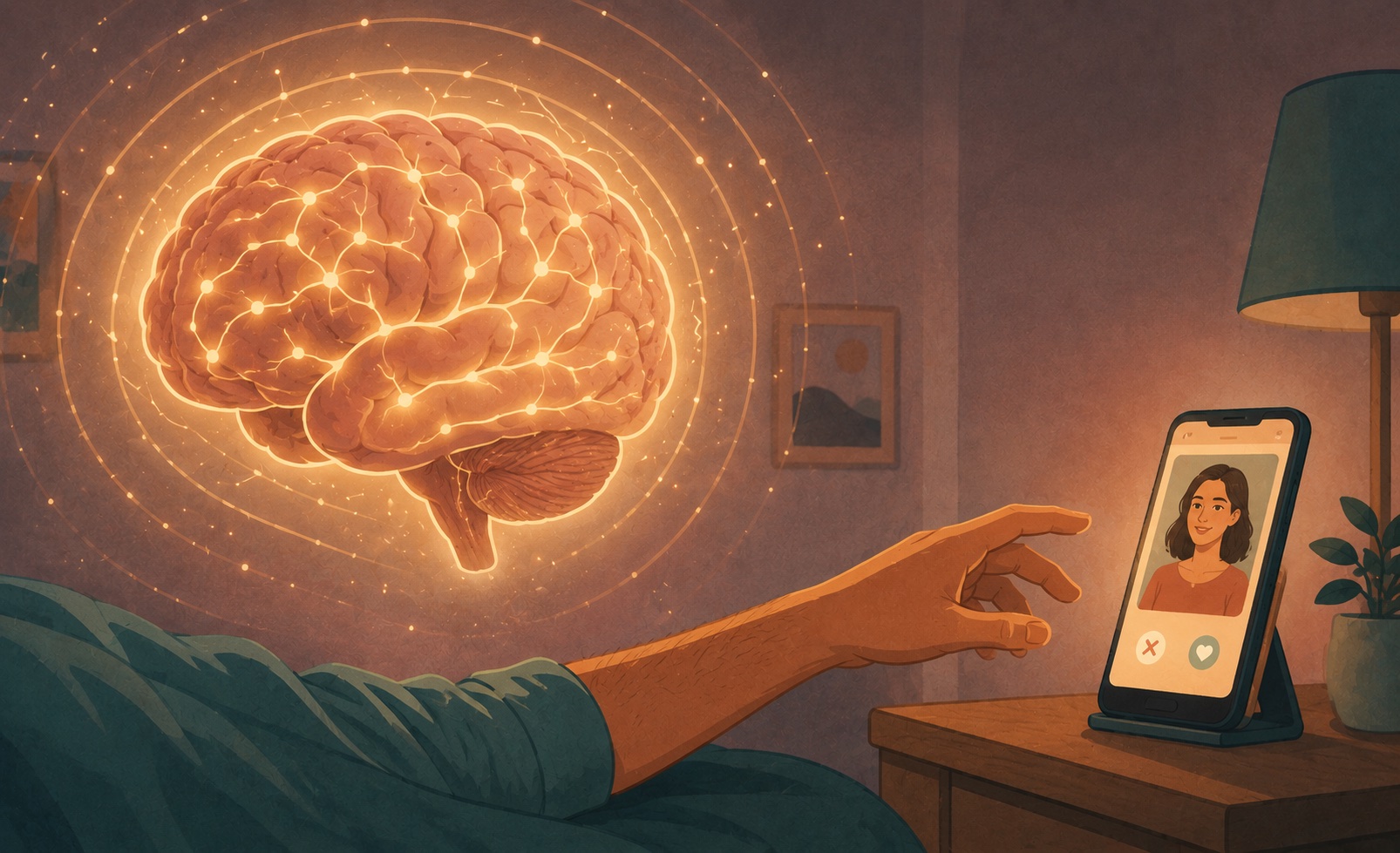
🧠 💘 📱 🐠 ⚡ 🤔 💬 ✅
TL;DR: Your brain starts committing to a social approach several seconds before you move toward someone — meaning the gut feeling that told you he was a green flag was a peer-reviewed neural event, not intuition.
The Situation
There is a specific kind of TikTok that has been circulating heavily this year, and you have seen it. A woman is describing a man she is seeing, and the first thing she says is: "I just knew. Before he even opened his mouth." He was soft. He asked how her day went. He remembered the thing she said three weeks ago about her sister's cat. He was, in the language of the moment, a green flag — and she felt it before he demonstrated it.
This is widely understood as a vibe. A feeling. Something intuitive, perhaps chemical, possibly embarrassing to admit to. Women across TikTok, X, and Reddit have spent considerable energy this year cataloguing the specific micro-behaviours that trigger this response — the unhurried eye contact, the gentle voice, the absence of performance — and debating whether the gut reaction to these signals should be trusted at all.
It should. Researchers at the Hebrew University of Jerusalem have now published findings in Nature Communications confirming that social approach behaviour — the decision to move toward another individual — begins as a coordinated, brain-wide neural event several seconds before any physical movement occurs. The study monitored brain activity at single-cell resolution in zebrafish as they decided whether to swim toward a companion. What the researchers found is that the brain does not wait for a reason to approach someone. It begins building the decision long before the body follows.
By the Numbers
Key findings from Lifshitz et al., Nature Communications, June 2, 2026:
| Finding | Detail |
|---|---|
| Neural pre-decision onset | Several seconds before observable social movement |
| Brain regions involved | Coordinated activity across multiple regions simultaneously |
| Pallium role | Activity increased in this higher-order region while simultaneously decreasing elsewhere |
| Individual variation | Fish with a stronger pre-decision signal were measurably more social overall |
| Predictive power | The signal predicted both whether an action would be social and how socially driven the individual is |
The pallium has functional analogues in human brains. The researchers explicitly noted the findings may offer clues to human social function and conditions in which social behaviour is altered or disrupted.
The Deeper Question Nobody Asked
What this research establishes — with the caveat that it was conducted on zebrafish rather than on people in a bar, which does admittedly represent a methodological gap — is that your brain has been pre-deciding your social approach trajectory for several seconds before you consciously register any preference. The green flag discourse, the "I just knew" testimonials, the feeling that arrived before the evidence: these are not soft or sentimental reports. They are, per the pallium, a distributed neural event that was already building while you were still reading his bio. The only remaining question is whether zebrafish swipe right.
Sources
- Your brain starts making social decisions before you do — ScienceDaily, June 2, 2026; summary of Lifshitz et al., Hebrew University of Jerusalem
- Distinct distributed neural dynamics predict pallium-dependent social approach — Lifshitz, Prag, Livneh et al., Nature Communications, 2026
Related Content
- Science Explains Why You Block People After One Unanswered Text
- The Reason Your Childhood Sleepover Memories Are Unnervingly Clear Is Now Peer-Reviewed
- Your AI Doesn't Understand You. Scientifically, the Bees Might.
Tags: neuroscience dating social-behavior attraction green-flags